"There is a legend about a spindly little sparrow who is lying on his back in the middle of the road. A horseman comes by and dismounts, and asks the sparrow what on earth he is doing lying there upside down like that. 'I heard the heavens are going to fall today,' said the sparrow. 'Oh!' said the horseman, 'and I suppose your puny little legs can hold up the heavens?'
'One does what one can,' said the sparrow, 'one does what one can.'" (William A. Jenkins)
"Here is the list of Greeters for the month of June 2019
……….June 13, 2019...…….Tim Tippett
……….June 20, 2019...…….John Roppolo
……….June 27, 2019...…….Rhonda White
Attendance on June 6th, 2019
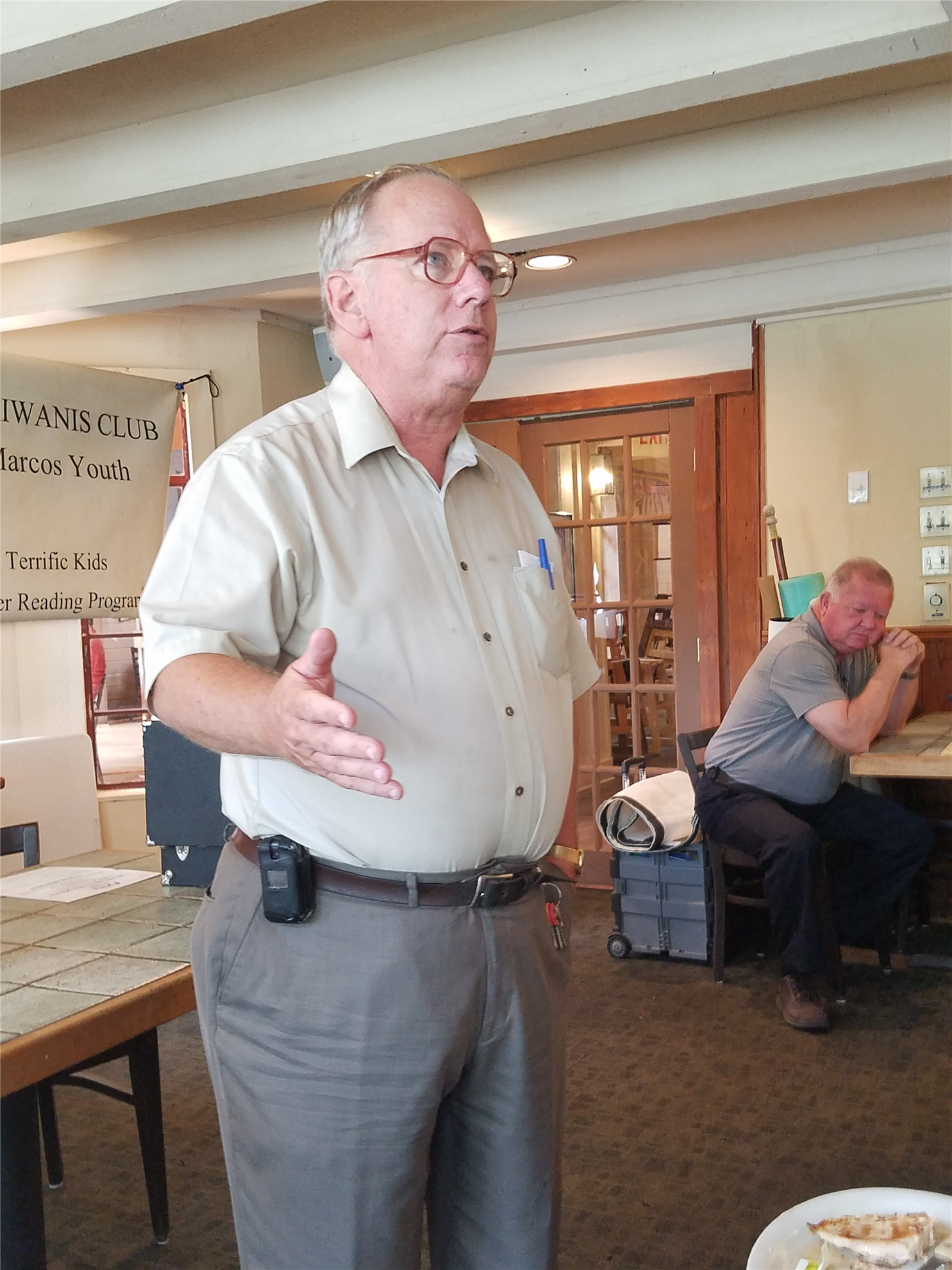
Doug Balkman, Jeanne Balkman, Chester Banks, Del Brown, Pam Cook, Moe Johnson, Lon Shell, Charles Walts, Rhonda White, Ted Breihan, Beverly Crumley, John Polk, Merwin Richards, Glen Rydl, Gary Strunk, Tim Tippett (16)
Andrew Gary's name was pulled out of the Big Bucks Jar, but unfortunately he was not present. Sorry Andrew!
Happy Birthday to You in the Month of June!
………...June 28...……...Veronique Hahn
………….June 30...……...Francis Mendez
Anniversaries celebrated in May!
…….June 7...…..John & Mary Polk
…….June 30......Del & Marie Brown
The Program for this coming Thursday,
Garry White will be bringing the program for this coming Thursday.
"Our Flag"!
Since June 14 is flag day, and we are going to put our flags out on that day, here's something to think about regarding 'Our Flag'
"Our Flag is Francis Scott Key standing aboard sa British vessel on September 13, 1814, watching the Redcoats pouring 1,500 to 1,800 shells, rockets and bombs on Ft. Henry......It is Betsy Ross sewing together the first flag for the Revolutionary Army....The colors of the Union Army flying in the Civil War; the charge up San Juan Hill.
….It is the Argonne, the Boxer Rebellion, Chateau Thierry, the war with Mexico and the banner off yellow-ribboned calvarymen chasing Indians in the great Southwest or pursuing Pancho Villa into Mexican mountains.
…..It is the symbolic raising of the flag at Iwo Jima in World War IIK and its unfurling over the liberated cities of Italy, France and Germany.
….It's the love of the country for which it stands; the love of the land itself, the love of liberty, freedom and the symbol of what humanity may do when wars are over....
In all conflicts there have been some Americans who have disagreed; a few who were traitors. But that very flag that they have disagreed or desecrated is the symbol of their American right to disagree".....(Indianapolis Star)
From June 7th to June 13
June 7, 1965 - - The U.S. Supreme Court struck down a Connecticut law banning contraception in Griswold v. Connecticut, the Supreme Court guaranteed the right to privacy, including freedom from government intrusion into matters of birth control.
June 8, 1874 - - Apache leader, Cochise died on the Chiricahua Reservation in southeastern Arizona. After a peace treaty had been broken by the U.S. Army in 1861, he waged war against settlers and soldiers, forcing them to withdraw from southern Arizona. In 1862, he became principal chief of the Apaches. He and 200 followers avoided capture by hiding in the Dragoon Mountains. In June of 1871, Army General George Crook assumed command in Arizona and managed to win the allegiance of many Apaches. Cochise then surrendered. He disappeared briefly in the spring of 1872, but returned and settled on the reservation where he died.
June 9, 1898 - - The British signed a 99 year lease for Hong Kong, located on the southeastern coast of China. Hong Kong, consisting of an area measuring 400 square miles, was administered as a British Crown Colony until July 1, 1997, when its sovereignty reverted to the People's Republic of China.
June 10, 1942 - - In one of the most infamous single acts of World War II in Europe, all 172 men and boys over age 16 in the Czech village of Lidicd sdrd shot by Nazis in reprisal for the assassination of SS leader Reinhard Heydrich. The women were deported to Ravensbruck concentration camp where most died. Ninety young children were sent to the concentration camp at Gneisenau, with some later taken to Nazi orphanages if they were German looking. The village was then completely leveled until not a trace remained.
June 11, 1994 - - After 49 years, the Soviet military occupation of East Germany ended. At one time there had been 337,800 Soviet troops stationed in Germany. Over 300,000 Russians died during World War II in the Battle for Berlin.
June 12, 1898 - - The Philippines declared their independence from Spain. The islands were named after King Philip II. Once freed from Spain, the islands were then invaded and occupied by U.S. forces. They became and American colony and remained so until after World War II.
June 13, 1971 - - The New York Times began publishing the Pentagon Papers, a collection of top secret documents exposing U.S. strategy in the Vietnam War.
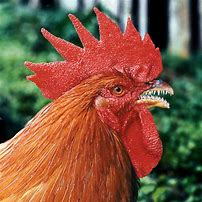
Have You Ever Heard the Phrase, "As Scarce as Hen's teeth"?
"No one has ever yet found teeth in a hen, nor is likely to; so this is just another example (American) of exaggerated statement not intended to be taken literally. One might say, 'Elephants in Greenland are scarcer than hen's teeth,' meaning that elephants are not to be found in Greenland. Just when this hyperbole first appeared has not yet been determined. But because this metaphor is thoroughly familiar in all parts of the country, there's good reason to believe that it may actually have had word-of-mouth use from colonial days."
"Three women started boasting about their sons, 'What a birthday I had last year!' exclaimed the first. 'My son, that wonderful boy, threw me a big party in a fancy restaurant. He even paid for plane tickets for my friends.'
'That's very nice, but listen to this,' said the second. 'Last winter, my son gave me an all-expenses-paid cruise to the Greek islands. First class.'
'That's nothing!' interrupted the third. 'For five years now, my son has been paying a psychiatrist $150 an hour, three times a week. And the whole time he talks about nothing but me.'"
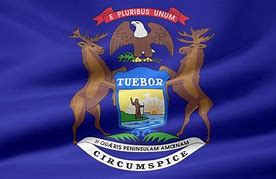
History of the Michigan State Flag
Michigan's official flag was adopted in 1911. The flag has a deep blue background and pictures an elk and moose around a blue shield labeled "TUEBOR", meaning "I will defend." The shield pictures a man with a raised hand and a gun, a rising sun, a peninsula and lakes )representing Michigan's geography) Over the shield is a bald eagle (holding an olive branch and a sheaf of three arrows) and a red ribbon reading "E PLURIBUS UNUM" (which is the motto of the U.S.A. and means 'Out of Many, One' - this refers to the states of the United States being united into one country). Under everything lie two white ribbons that read 'SI QUAERIS PENNINSULAM AMOENAM' and CIRCUMSPICE,'which means, 'If you are seeking a amenable (pleasant) peninsula, look around you.'"
How About Some More Exponderables!
1...…..Why do we put shirts in a suitcase, and put suits in a garment bag?
2...…..If I melt dry ice, can I take a bath without getting wet?
3...…..Why do we say 'a pair of pants' when there is only one article of clothes?
4...…..Why do wise guy and wise man mean entirely different things?
5...…..Why do your feet smell and your nose runs?
6...…..If rabbits' feet are so lucky, then what happened to the rabbit?
7...…..If space is a vacuum, who changes the bags?
8...….Why does the sun lighten our hair, but darken our skin?
9...….Why doesn't Tarzan have a beard?
10.....Why don't they call mustaches 'mouthbrows"?
See if you remember these 'Myth Information'
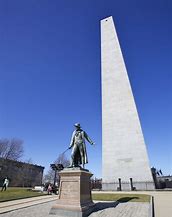
"The famous Revolutionary War conflict known as the Battle of Bunker Hill was actually fought on nearby Breeds Hill. The site of the battle is even commemorated by a 221-foot-high granite obelisk that stands on Breeds Hill.
The Battle of Bunker Hill was the first major engagement of the Revolutionary War and was fought for the control of Boston. The Americans under the command of Colonel William Prescott, were ordered to fortify Bunker Hill. For some reason still unexplained, Prescott went beyond Bunker and established his position on Breeds Hill. The original battle reports ignored the error, which was never corrected, and it has been known ever since as the Battle of Bunker Hill.



 "There is a legend about a spindly little sparrow who is lying on his back in the middle of the road. A horseman comes by and dismounts, and asks the sparrow what on earth he is doing lying there upside down like that. 'I heard the heavens are going to fall today,' said the sparrow. 'Oh!' said the horseman, 'and I suppose your puny little legs can hold up the heavens?'
.jpg) "
"
.jpg)
 Andrew Gary's name was pulled out of the Big Bucks Jar, but unfortunately he was not present. Sorry Andrew!
 Have You Ever Heard the Phrase, "As Scarce as Hen's teeth"?