
banner
Club Information
San Marcos Noon Kiwanis - We Build!
San Marcos Noon
Kiwanis is for Kids:"Every Child Is a Story not Yet Told"
We meet Thursdays at 12:00 PM
Grin's Restaurant
802 N LBJ Dr
San Marcos, TX  78666
United States
VenueMap Venue Map
Executives & Directors
President
 
Secretary
 
Treasurer
 
Webmaster
 
Past President
 
President Elect
 
Site Pages
About Our Club
Committees and Functional Responsibilities for 2016-2017
Annual projects - Texas Ramps
Annual Projects - Pancake Day
Annual Projects - Silent Auction (with Pancake Day
Annual Projects - Flag displays
Annual Projects -Veterans Day
Annual Projects, Camp McBride Wilson Youth Camp
Annual Projects - Disaster Backpacks
Kiwanis Clubs in District 38
Weekly Programs - 2016
Annual Family Social..Cp McBride Wilson Youth Camp
Greeter Schedule for 2016-2017
Links
Links
K Notes Newsletter
Kiwanis Int'l Foundation
Links
Links
TX OK Kiwanis District
Stories
E-Bulletin for March 5th, 2020  (Item 291)
"One of the most tragic things I know about human nature is that all of us tend to put off living.  We are all dreaming of some magical rose garden over the horizon instead of enjoying the roses that are blooming outside our windows today."  (Dale Carnegie)
Attendance at our Pancake Day.
    We had a fantastic day last Thursday at our annual Pancake and Silent Auction display.  A great big THANKS!!! to everyone that came out, helped set everything up to get ready for almost 400 persons to eat our delicious regular pancakes, our chocolate chip pancakes, our blueberry pancakes, and those delicious sausages.  Everything was just perfect.  Everyone had a task to perform and everyone did their tasks very proficiently.  
     Thanks to everyone who brought silent auction items from the community or individually.  The results have not been figured out yet, but considering the many good comments we heard from people, they were well pleased with all items on display.
     Special thanks to Doug & Jean Balkman who 'honcho'd' the entire meal, and giving everyone in our club some task that needed to be done.  A  great big thanks to Pam Cook and Kelli Whigham and those who helped them in collecting auction items, cataloging each item for both morning and evening displays.  This entire day is one of our biggest fundraiser, and could not have been done without full support of our whole club, and especially everyone from our community who purchased tickets.  We heard nothing but great comments from everyone.


               GREETERS FOR THE MONTHS OF  MARCH & APRIL 2020
 
March 5.........Kelly Lane
March 12.......Tim Tippets
March 19........Rhonda Young
March 26........Gary Strunk
 
April 2.............Glen Rydl
April 9.............Merwin Richards
                                         April 16............Francis Mendez
                                         April 23............Garry White
                                         April 30............Andrew Gary


"An engineer, a mathematician, and a physicist were standing around the university flagpole when an English professor wandered by. 'What are you doing?' he asked.  'We need to know the height of the flagpole,' answered one, 'and we're discussing the formulas we might use to calculate it.'  'Watch!' said the English professor.  He pulled the pole from its fitting, laid it on the grass, borrowed a tape measure and said, 'Exactly 24 feet.'  Then he replaced the pole and walked away.
   'English professor!' sneered the mathematician.  'We ask him for the height, and he gives us the length.'"

History Facts from February 28 - March 5th
 
February 28, 1844 - - - During a demonstration of naval fire power, one of the guns aboard the USS Priancton explodged, killing several top U.S. government officials on the steamer ship, and narrowly missed killing President John Tyler.
March 1, 1961 - - - President John F. Kennedy established the Peace Corp, an orfganization sending young American volunteers to developing countries to assist with health care, education and other basic human needs.
March 2, 1943 - - - During World War II in the Pacific, a Japanese convoy was attacked by 137 American bombers as the Battle of Bismarck Sea began.  The convoy included eight destroyers and eight transports carrying 7,000 Japanese soldiers heading toward New Guinea.  Four destroyers and all eight transports were sun, resulting in 3,500 Japanese drowneed, ending Japanese efforts to send reinforcements to New Guinea.
March 3,  1913 - - - A woman's suffrage march in Washington D.C., was attacked buy angry onlookers while police stood by.  The march occurred the day before Woodrow Wilson's inaururation.  Many of the 5,000 women participating were spat upon and struck in the face as a newar riot ensued.  Secretary of War Henry Stinson then ordered soldiers from Fort Myer to restore order.
March 4, 1933 - - - Newly elected President Franklin D. Roosevelt took office and delivered his first inaurural address attempting to restore public confidence during the Great Depression, stating, 'Let me assert my firm belief that the only thing we have to fear is fear itself....'  His cabinet appointments included the first woman to a Cabinet post, Sexcretary of Labor, Frances Perkins.'
March 5, 1946 - - - The 'Iron Curtain' speech was delivered by Winston Churchill at Westminster College in Fulton, Missouri.  Churchill used the term to describe the boundary in Europe between free countries of the West and nations of Eastern Europe under Soviet Russia's control.


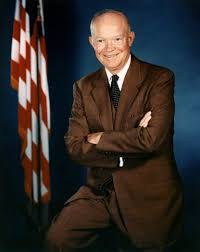
"Know Your Presidents - -Dwight David Eisenhower

 
     "Dwight D. Eisenhower was the 34th President of the United States and served in that capacity from 1953 - 1961.  Eisenhower's most popular nickname is Ike.  His classmates gave him the nickname Little Ike to distinguish him from 'Big Ike', his older brother Edgar."
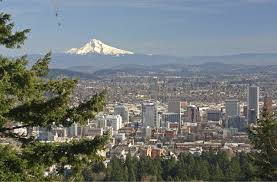
Where Did Oregon get it's Name?
 
     " Oregon was named after the River of the West, also called the Oregon.  In 1778, explorer Jonathan Carver published an account of his travels in the West and used the word Oregon to describe the river.  It may come from the Indian word ouragan, meaning 'birch-bark dish.'"
"Climax, Minnesota"
 
     "This small town in northern Minnesota was named in the 1890s after a member of the well-to-do Seenerson family found some Climax Chewing Tobaccco on the ground while moving into their new home.  Since the settlement was nameless, a decision wade to call it Climax."
"What Do We Mean when we say 'Red Herring?'
     "The expression red herring, meaning any device to confuse or divert attention, got its name from a hunting practice.  A red herring dragged across a fox's trail destroys the fox's scent that has been laid and diverts the dogs' attention to a false trail."
""Teddy Bear!"
"Toy Bears became popular in Germany around the turn of the century.  In the fall of 1902 they were imported into the United States.  At about that time President Teddy Roosevelt went on a hunting trip in Mississippi.  It was reported that her refused to shoot a small bear that was brought into his camp for that purpose.  Cartoonist Clifford Berryman was inspired by this and drew a cartoon of the incident, labeling it 'Drawing the Line in Mississippi.'  The public, highly amused by the whole thing, began to associate the popular toy bears with Teddy's hunting adventures, and the term Teddy bear became nationally known.
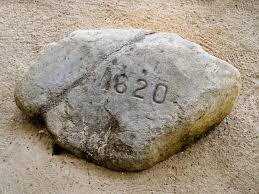
   "The landing of the Pilgrims at Plymouth Rock evokes familiar images for most people.  Unfortunately, many of these popular ideas are untrue.
     The original destination of the Mayflower was not Massachusetts, where the ship actually landed.  The charter of the Mayflower stipulated that its destination was to be Virginia.  The exact reasons why the voyage terminated in New England are not known for certain.  The Mayflower's journal recorded only that they were running out of 'victuals and beer', indicating that their provisions may have run low.
     The first landing of the Mayflower was not at Plymouth as is usually believed, but at Cape Cod harbor on November 21, 1620.  The Mayflower remained anchored at that location for four weeks while an exploring party set out in a small boat in search of a permanent place to settle.
     Therefore, the historic landing at Plymouth was not made from the Mayflower as is usually depicted in paintings and sketches.  When the small scouting party stepped ashore, it was done from the little open boat.  They returned to the Mayflower and sailed into Plymouth harbor on the more well-known date of December 20, 1620.
     Contrary to popular belief, all aboard the Mayflower were not Pilgrims.  Of the 102 passengers who left England, only about forty were the religious dissidents with whom we are familiar.  The rest were along simply seeking adventure or financial gain, were servants accompanying their masters, or, as with Miles Standish, were paid military leaders to protect the group.
     The well known Mayflower Compact was not written at sea, was not an attempt to create democratic rule, and was not the first establishment of democracy in America.  The compact was written two days after the landing in a desperate effort to quell the turmoil and dissension that threatened the group's survival.  Also, representative democracy was established first at Jamestown, Virginia, in the House of Burgesses the year before the Mayflower Compact.     The now-famous Plymouth Rock is never even mentioned in any of the Pilgrims' early chronicles.  The name itself, and the entire story surrounding the the rock as the place where the Pilgrims first stepped ashore, was not ever heard until one hundred twenty years after the historical landing.
     In 1741, Elder John Faunce somehow identified the boulder as the original landing site.  The legend started by Elder Faunce did not receive great popularity until it was revived eighty years later during the 1820 bicentennial celebration of the Pilgrims' landing when the story suddenly became widely believed.
     The symbol of the first permanent English settlement in New England, Plymouth Rock was removed from its original site near the shore in 1774, at which time it accidentally split in half.  The two pieces were separated for over one hundred years, while one was used as a step for a building entrance.  They were rejoined in 1880 at what was believed to be the rock's original location.
     The Pilgrims never did refer to themselves as Pilgrims.  When leaving England, they called themselves Separatists, from the English Separatist Church to which they belonged.  After landing at Plymouth, the name Old Comers was briefly used, but they later became commonly known as the Forefathers.
     The term Pilgrim first appeared two centuries later in an 1820 bicentennial ceremony by Governor William Bradford, who referred to them as 'saints' and as the 'Pilgrim Fathers.'  The name Pilgrim was used again by Daniel Webster, and its popularity was thus established.'"  ("Myth Information by J. Allen Varasdi)